
The History and Science of Boomerangs: From Ancient Tool to Modern Sport
Discover the 20,000-year journey of humanity's original flying machine — from Aboriginal hunting grounds and pharaoh's tombs to World Championship arenas. Includes the fascinating physics behind why boomerangs actually return.
Published May 30, 2026
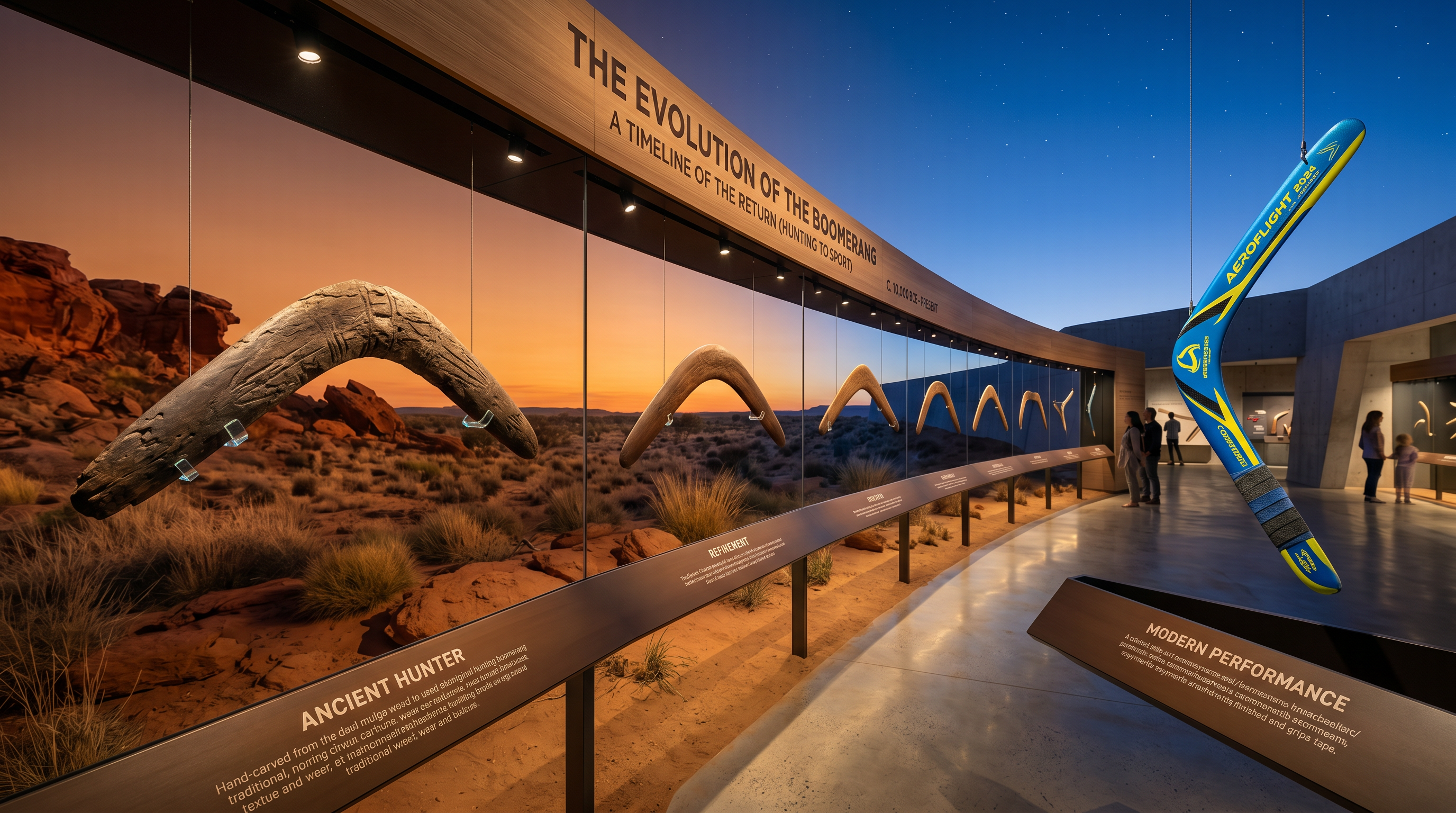
The History and Science of Boomerangs: From Ancient Tool to Modern Sport
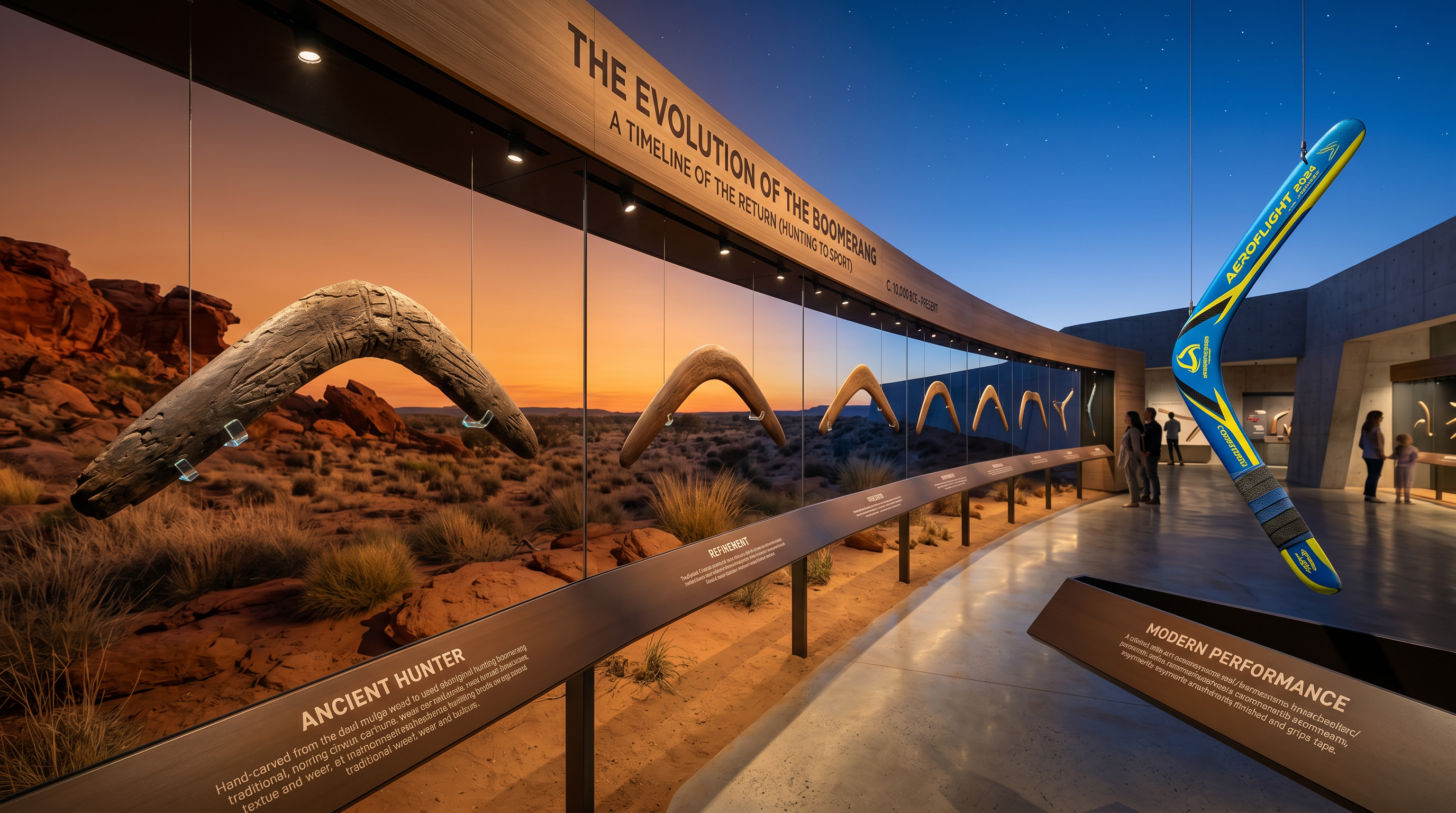
From Aboriginal hunting grounds to Olympic sports arenas — the incredible 20,000-year journey of humanity's original flying machine.
Introduction: The Boomerang Is Humanity's Oldest Flying Machine — 20,000+ Years of Innovation
Before the airplane, before the glider, before even the wheel, humans were engineering aerodynamic flying objects. The boomerang — simple, elegant, and deeply sophisticated — represents one of the most remarkable feats of intuitive physics in human history.
Indigenous Australians, along with ancient Egyptians, Poles, and Native Americans, independently discovered and refined these curved throwing sticks over tens of thousands of years. Today, that same ancient design powers a global competitive sport, inspires aerospace research, and brings joy to millions of people worldwide. Here's the full story.
Section 1: Ancient Origins — Older Than You Think
The Aboriginal Australian Boomerang (50,000 BCE–Present)
Most people associate boomerangs exclusively with Australia — and for good reason. Aboriginal Australians have been crafting and using boomerangs for at least 10,000 years, with some estimates suggesting up to 50,000 years of use.
However, a crucial distinction: the most common Aboriginal boomerangs were NOT designed to return. The curved throwing stick — called a "kylie" or "woomera" in different languages — was primarily a hunting weapon. Thrown low and fast, it could travel 50–100 meters and strike animals or birds with devastating force. Non-returning hunting boomerangs were also used for digging, musical percussion (clapsticks), and fire-starting.
The returning boomerang was likely a joyful discovery — a differently-shaped hunting tool that, when thrown a certain way, curved back. Aboriginal communities developed the returning design as a training toy and game, long before Europeans arrived.
The World's Oldest Known Boomerang (Poland, 20,000 BCE)
In 1987, archaeologists excavating a cave in southern Poland discovered something extraordinary: a boomerang made from a mammoth tusk, dated to approximately 20,000 years ago. This single artifact shattered the assumption that boomerangs were uniquely Australian — proving that this aerodynamic principle was discovered independently across multiple continents and civilizations.
Ancient Egypt and the Pharaohs' Boomerangs
Tutankhamun's tomb (circa 1323 BCE) contained an astonishing collection of boomerangs — both returning and non-returning types. Decorated with intricate painted designs, these boomerangs suggest that the young pharaoh was an avid thrower. Ancient Egyptian murals also depict hunting scenes using curved throwing sticks, confirming widespread use throughout the ancient world.
Section 2: The Science of Return Flight — How Does It Actually Work?
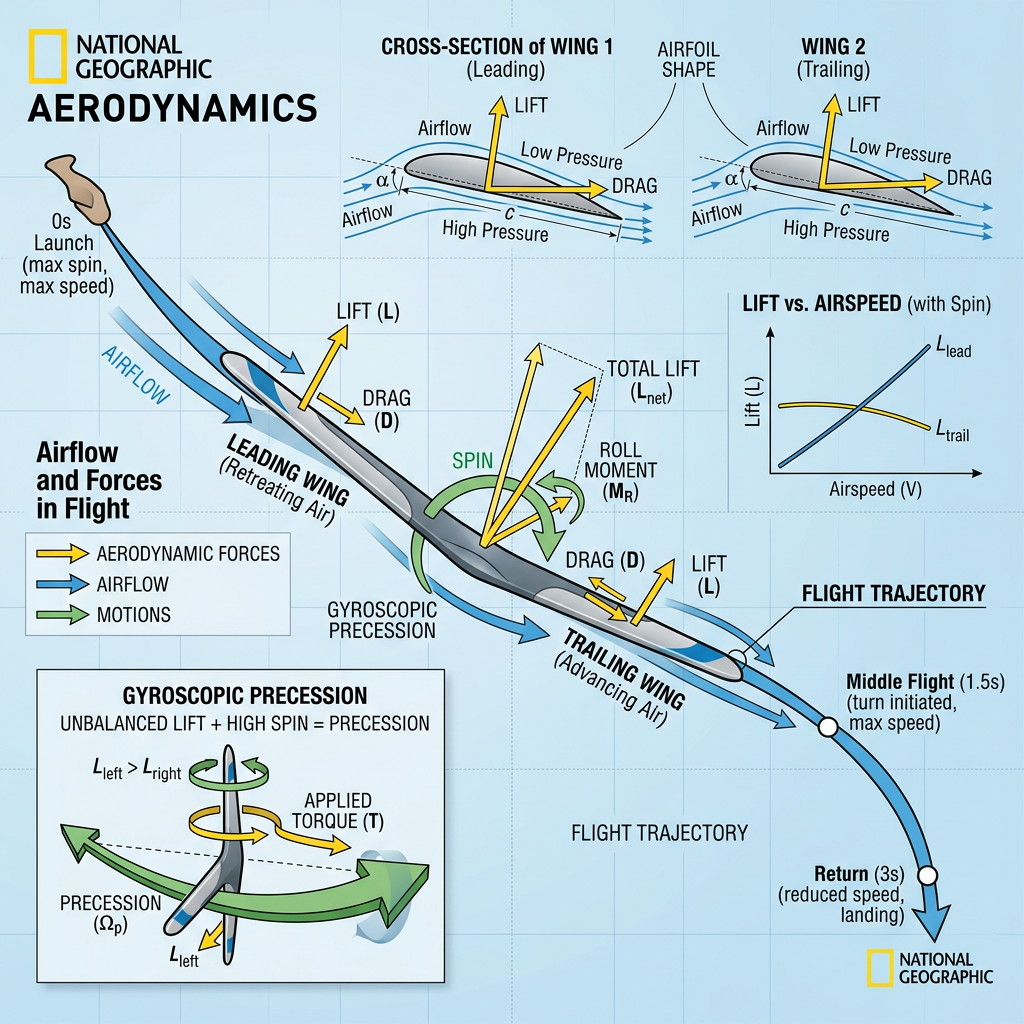
Diagram showing airflow over boomerang wings, gyroscopic precession vector, and the resulting circular flight path.
The Bernoulli Principle on Spinning Wings
A boomerang is essentially two wings joined in a V or tri-blade shape. Each wing has an airfoil profile — flat on one side, curved on the other (like an airplane wing). As the boomerang spins through the air, each wing generates lift according to Bernoulli's principle: faster airflow over the curved top surface creates lower pressure, generating upward force.
Why Does It Return? Gyroscopic Precession
Here's where it gets fascinating. The top wing (moving forward relative to the spin direction) travels faster through the air than the bottom wing. This means the top wing generates more lift than the bottom wing — creating an imbalance.
In a non-spinning object, this imbalance would simply tip the object over. But a spinning object behaves differently due to gyroscopic precession: any force applied to a spinning object causes it to tilt 90° from the direction you'd expect. This is the same principle that keeps a spinning top upright.
So the lift imbalance doesn't flip the boomerang — instead, it causes the flight path to curve sideways, tracing a circular arc that brings the boomerang back to the thrower.
Angular Momentum
The angular momentum of the spinning boomerang keeps it stable throughout this circular flight. A boomerang that isn't spinning enough will wobble and fall; too much spin and the return radius becomes very tight. The perfect throw balances spin rate with forward velocity for a smooth, wide circular return path.
Section 3: Evolution of Design — From Hunting Weapon to High-Tech Sport Equipment
The timeline of boomerang evolution:
| Era | Material | Use | Design |
|---|---|---|---|
| 20,000 BCE | Bone, tusk | Hunting | Simple curved stick |
| 10,000 BCE | Wood (hardwood) | Hunting, ceremony | Refined angle, better aerodynamics |
| 1800s CE | Carved wood | Recreation, demonstration | Returning designs popularized globally |
| 1960s | Plywood (7-ply) | Sport competition | Precise aerodynamic profiles |
| 1990s | Carbon fiber, fiberglass | World championships | Competition-optimized designs |
| 2025 | EVA foam, carbon fiber | Recreation + elite sport | Materials for every skill level |
The biggest revolution was the shift from hardwood to Baltic birch plywood in the mid-20th century. Layered plywood allowed precise shaping of the aerodynamic profile — impossible with solid wood — and dramatically improved return consistency. Carbon fiber composite, adopted in competitive circles from the 1990s onward, brought aerospace-level precision to the sport.
Section 4: Boomerang as Competitive Sport
The World Boomerang Championships have been held since 1981, with athletes from over 20 countries competing across multiple disciplines:
- Accuracy — return and land closest to the throwing circle
- Fast Catch — most catches in 5 minutes within a marked area
- Maximum Time Aloft (MTA) — boomerang stays in the air longest before being caught
- Long Distance — maximum return distance (current world record: 238m!)
- Trick Catch — catch behind back, between legs, or while blindfolded
- Endurance — most catches in a 1-hour period
Australia, Germany, the United States, and France consistently dominate world championships. The sport requires precise engineering of custom boomerangs for each event type — serious competitors may own 20–50 specialized boomerangs.
Section 5: Collecting Boomerangs — Where Sport Meets Art
Beyond competition, boomerangs have a rich tradition as decorative objects and cultural art:
Aboriginal Ceremonial Designs: Traditional Aboriginal boomerangs featuring dot painting, X-ray art, or Dreamtime story imagery are collected worldwide as fine art. Authentic pieces by recognized Aboriginal artists can sell for hundreds to thousands of dollars.
Modern Art Collaborations: Contemporary artists create boomerangs as canvas for unique visual art — wall-display pieces that are also fully functional as sporting equipment.
Material Specimens: Collectors assemble sets showcasing different materials, eras, and origins — a museum in miniature.
Competition Archive: Legendary competition boomerangs from world championship events have historical significance and rarity value.
Section 6: Getting Started Today — From Ancient Fascination to Your Backyard
The boomerang's 20,000-year journey has brought it from mammoth tusk in a Polish cave to the hands of millions of recreational throwers worldwide. The design principles discovered by ancient humans remain fundamentally unchanged — what's different is the materials, the precision, and the accessibility.
You don't need special training, expensive equipment, or a large budget to experience the same satisfaction that fascinated ancient Egyptians and Aboriginal Australians. A good EVA foam boomerang, an open park, and 30 minutes of practice is all it takes.
Explore Our Full Collection — From Beginner to Competition Grade →
History in your hands. Free US shipping. Ships in 2–3 days.
Ready to get started?
Explore the boomerangs mentioned in this guide and checkout securely with Stripe.
Shop now →More guides

Boomerang Guide
7 Best Outdoor Gift Ideas for Active Families (Summer 2025)Skip the screens this summer and give the gift of outdoor adventure. From boomerang starter sets to lawn games, here are 7 active family gifts that get everyone moving, laughing, and making memories together.
Boomerang Guide
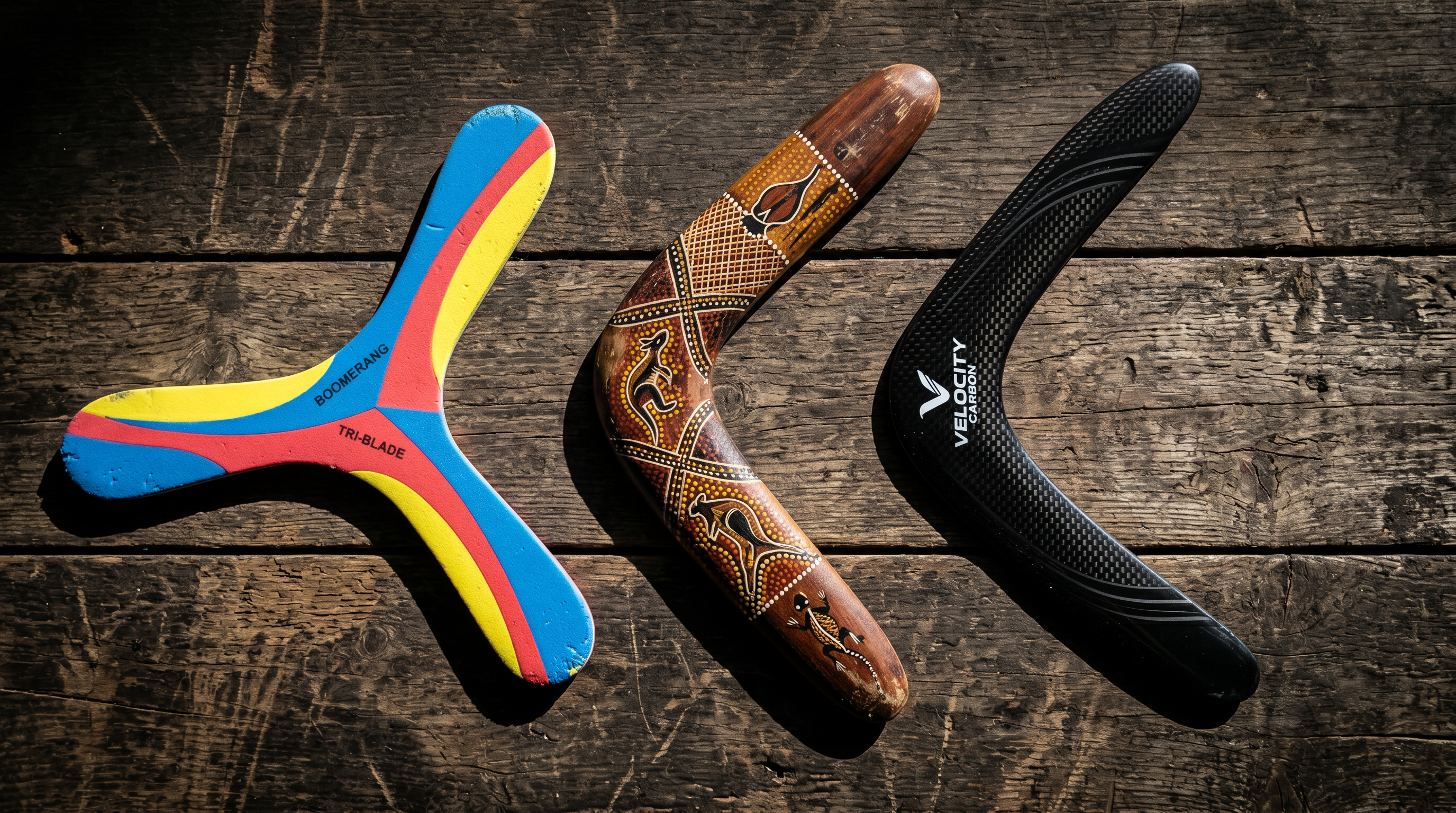
Boomerang Buying Guide: Foam vs Wood vs Carbon Fiber — Which Is Right for You?Not sure which boomerang to buy? This complete guide compares EVA foam, wooden, and carbon fiber boomerangs across price, performance, safety, and skill level — with a clear decision matrix to find your perfect match.

Boomerang Guide
10 Best Boomerangs for Kids in 2025: Safe, Fun & Parent-ApprovedOur top picks for safe, durable, and genuinely fun kids' boomerangs — tested and parent-approved. Includes age guides, safety tips, and creative outdoor games to keep children engaged all summer.